Grief support
The Pressure to Grow From Grief — And Why You Don't Have To
If you've spent years measuring your worth by productivity, achievement, and constant self-improvement, that habit doesn't vanish the moment loss enters your life. Even as your world falls apart, that familiar inner voice keeps repeating the same old messages. Layered on top of raw suffering, that drive toward endless forward motion can turn grief into just another obstacle to conquer — something to "get past" through sheer self-improvement. Without quite meaning to, you find yourself chasing growth as if it were the point of grieving.
This pressure often surfaces as quick, reflexive thoughts: "I need to stay positive and turn this into something good," or "I should use this pain to help other people." Those thoughts rarely come from nowhere — they're an extension of messages, both subtle and obvious, that surround us constantly.
Consider a small, telling example. One writer working on this very topic received a package in the mail from a new email service provider — a free thank-you gift for signing up. Inside were two items that made the point better than any argument could:
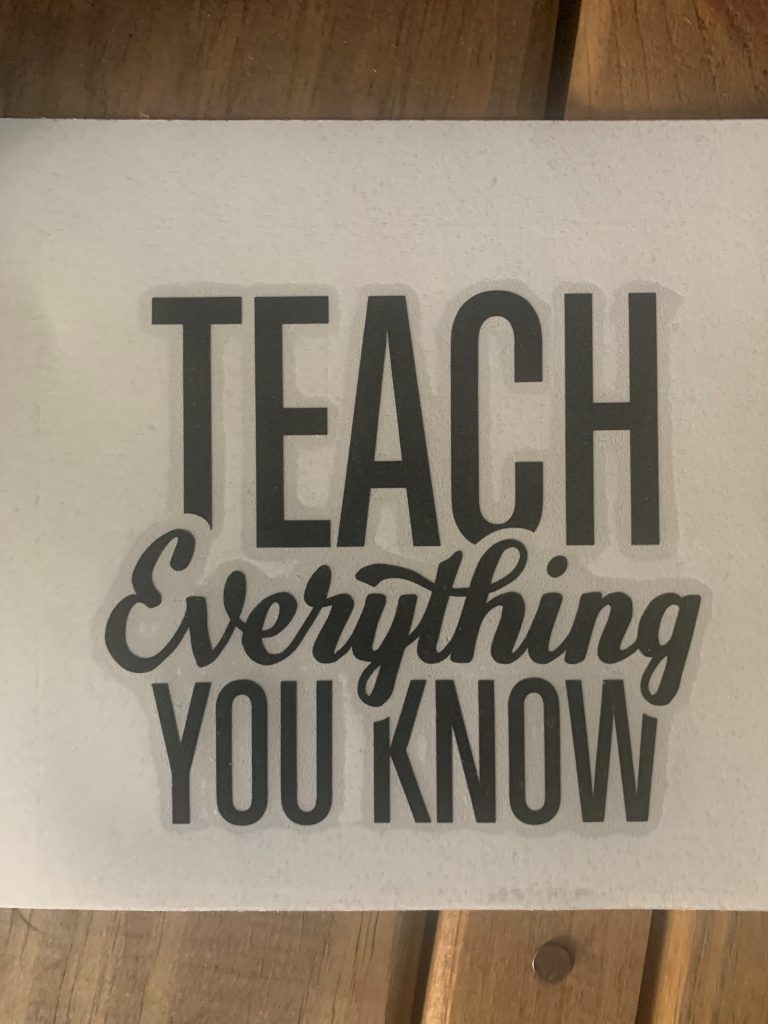

Free gifts urging you to "create every day" and "teach everything you know" — sent by an email company, of all things. It's easy to see why our default thinking pushes us to transform pain into something "useful" or meaningful.
To be clear, this pressure doesn't always register as unwelcome. It's so woven into how we think that it can feel like simple common sense. Sometimes it even feels good — genuinely good. Chasing growth can offer a sense of control at a time when control feels impossible to find. Staying busy trying to grow from loss can also be a convenient distraction, keeping you in motion instead of sitting still with the pain.
Where this becomes a problem
What gets lost in this rush is the simple truth that grief is meant to slow you down. It functions like a brake on the momentum of everyday life — a natural, built-in signal telling you to pause, to sit still, to mourn. Jumping straight to meaning-making can be a way of skipping past the reality of what's actually happened.
Social media tends to make this worse. Scroll for a few minutes and you'll find coaches promising to help you "transform" your grief. You'll see stories of people who built scholarship funds, annual fundraisers, and memorial golf tournaments in their loved one's name. You may admire what they've done, yet still feel like you're falling short for not doing something similar. The quiet pride of simply keeping your job, raising your kids, and holding your household together while grieving can start to feel small next to people building podcasts, memoirs, and public platforms out of their loss. That comparison only reinforces the belief that grief exists to be overcome — a springboard for growth or creation, not something to simply live through.
What sadness actually does
Yet slow, gentle grieving carries genuine value. Research shows that sadness sharpens memory and recall. Some researchers believe that sitting with the ache of yearning after a death actually helps the mind "relocate" the person you've lost into lasting memory.
Loss is a major physical stressor, and it can wear down the immune system. Allowing yourself to slow down while grieving gives your brain and body room to rest and recover. Sadness has also been shown to reduce certain judgment biases and sharpen people's ability to read others — an odd but well-documented effect. Studies have even found that sad people tend to be more attentive and more generous toward others.
None of this means meaning-making has no place in grief — it can be genuinely important. Nor does it dismiss the real value of gratitude during loss. And it certainly doesn't diminish post-traumatic growth when it happens; the growth some people find after devastating loss can be remarkable.
This is simply a reminder that growing from grief, or rushing to overcome it, was likely never actually your job.
Some people do eventually find meaning and growth, often much later than they expected. Others never do — and instead discover their own resilience, which is its own significant accomplishment. That resilience looks like living through devastation, staying present with the pain, and still finding a way to keep going. It shows up in small, ordinary moments: paying the bills, cooking dinner, noticing a sunset, hugging the people still in your life.
Neither path is more correct than the other. If there's ever a moment in life when it's fine to let up on the pace, this is it. Creating something every day, teaching everyone what you know, or forcing meaning onto an experience that isn't ready to offer any — none of that is required of you. Survival doesn't always have to make you stronger. Sometimes it's simply meant to leave you closer to your past, more grounded in your present, and gentler with yourself as you move into whatever comes next.
Create a memorial for the person you love
Start with their name. It is free, takes a minute, and no account is needed.
This article is general information, not professional legal, financial, tax, or medical advice. The right steps depend on your situation and the laws of your state — when it matters, check with a qualified professional.